Friday, 10 October 2014

BENEFITS OF NEUTERING AND SPAYING - MYTHS AND FACTS.


NEUTERING AND SPAYING

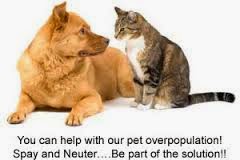
There is no question that overpopulation of Cats and Dogs in our society has become a huge problem.  Thousands of Cats and Dogs end up in pounds and shelters each year.  Some are adopted and some are saved by rescue groups and fostered until homes can be found.  But the sad fact remains that there are many who don’t escape “Death Row” and are euthanized simply because homes cannot be found and rescue groups are at full capacity running to the brim.

Compulsory spaying or neutering of all Cats and Dogs, would significantly reduce the number of animals ending up in pounds and shelters and being euthanized each year.


NEUTERING LAW IN SOME COUNTRIES

Different countries have different laws on sterilizing pet animals.

Norway       :  It is against the law to neuter a dog or any pet, as they believe it’s cruel.
Germany     :  It is mandatory to spay/neuter.
Canada        :  Focuses on dog and cat licensing.
USA            :  In many cities and towns, owners can be fined or their pets are denied
                       access to dog parks if their dogs are not neutered.  America also has
                       a dubious record of euthanizing 3 to 4 million shelter animals
                       every year.                      
India           :  Has the highest volume of spaying/neutering of stray dogs, many major cities 
                       have agreed to handle dog control without killing them.
Italy            :   Controls stray population through trap-neuter-return programs.
UK              :  RSPCA announced plans to end euthanasia on re-homable animals by 2017. 
                       But a success depends on major changes in the public behavior.

An organization “No KILL”, operating in many countries is striving to reach every healthy and treatable shelter dogs and cats to see they’re given a loving home.


WHAT IS SPAYING AND NEUTERING
                 
NEUTER:  A gender term which is neither masculine nor female.  
NEUTER - IN VETERINARY TERM:   To castrate or spay.                     
SPAY: In female - spaying involves abdominal surgery to remove the ovaries and uterus.

 NEUTER (CASTRATE):  
 In males - a relatively simple procedure that removes
 the testicles. This takes away the reproductive ability
 of the dog and also a lot of hormonal maleness.


Whether you've recently adopted a pet or you’re considering it, one of the most important health decisions you’ll make is to spay or neuter your cat or dog, which offers life-long health and other benefits.

There are many myths and wrong information doing the rounds that neutering is bad for your pet!

Check these top 10 reasons to spay or neuter your pet and check the myths that follow.


BENEFITS OF NEUTERING OR SPAYING YOUR PET

1.    Your female pet will live a longer and healthier life. Spaying helps prevent uterine infection and breast cancer, which is fatal in about 50 percent of dogs and 90 percent of cats. Spaying your pet before her first heat offers the best protection from these diseases.

2.   Neutering provides major health benefits for your male.  Besides preventing unwanted litters, neutering your male companion prevents testicular cancer, if done before six months of age.

3.    Your spayed female won’t go into heat.  While cycles can vary, female felines usually go into heat four to five days every three weeks during breeding seasons.  In an effort to advertise for mates, they’ll yowl and urinate more frequently, sometimes all over the house.

4    Your male dog won’t want to roam away from home.  An intact male will do just about anything to escape from the house, in search of mate.  And once he’s free to roam, he risks injury in traffic and fights with other males.

5   Your neutered male will be much better behaved.  Neutered cats and dogs focus their attention on their human families.  On the other hand, unneutered dogs and cats may mark their territory by spraying strong-smelling urine all over the house.  Many aggression problems can be avoided by early neutering.

6.    Spaying or neutering will not make your pet fat.  Don’t use that old excuse! Lack of exercise and overfeeding will cause your pet to pack on the extra weight, not neutering.  Your pet will remain fit and trim as long as you continue to provide exercise and monitor food intake

7.      It is highly cost-effective.  The cost of your pets spay/neuter surgery is a lot less than the cost of having and caring for a litter.  It also beats the cost of treatment when your unneutered Tom escapes and gets into fights with the neighborhood stray.

8   Spaying and neutering your pet is good for the community.  Stray animals pose a real problem in many parts of the country.  They can prey on wildlife, cause road accidents, damage local fauna, frighten children.  Spaying and neutering reduces the number of animals on street.

9.    Your pet doesn’t need to have a litter for your children to learn about the miracle of birth.  There are tons of books and videos available to teach your children about birth in a more responsible way.

10.  Spaying and neutering helps fight pet over-population.  Every year, millions of cats and dogs of all ages and breeds are euthanized or suffer as strays. These high numbers are the result of unplanned litters that could have prevented by spaying or neutering. 

RECOVERY PROCESS POST-OPERATION:

Although your dog may experience some discomfort after surgery, your vet can take various measures to control pain.
Here are tips for a safe and comfortable recovery:

Provide your dog with a quiet place to recover indoors and away from other animals.

Prevent your dog from running and jumping for the first few days following surgery.

Discourage your dog from licking the incision site, which may cause infection, by distracting your pet with treats, talking or patting or anything to take his mind away or by using an Elezabethan Collar.

Avoid bathing your dog for at least ten days after surgery.

Check the incision site daily to confirm proper healing.

If you notice any redness, swelling or discharge at the surgery site, or if the incision is open, please contact your vet. Also call your vet if your dog is lethargic, has a decreased appetite, is vomiting or has diarrhea following surgery.


MYTHS AND FACTS ON STERILIZATION:

Myth: It's better to allow your female to have one litter before she is spayed:

 Fact: Not true! There is no information to substantiate this claim. In fact, the best time to spay your female dog or cat is before her first heat. Here are the facts:
·         Spaying your female at a young age prevents uterine infections, such as pyometra, which can be fatal. Infections of the uterus are a major cause of illness in unspayed pets.
·         Spaying reduces the incidence of mammary (breast) cancer. This is a very common cancer in unspayed females, and the most common cancer to spread to the lungs.
·         Spaying can be done while your pet is pregnant. While this means aborting the offspring, it is more humane than taking them to the pound later. Also, for every litter you bring into the world, a litter at the pound dies.
·         Spaying eliminates unwanted males from harassing your pet.


Myth: Preventing pets from having litters is unnatural:

 Fact: We have already interfered with nature by domesticating dogs and cats. We domesticated the dog 15,000 years ago and the cat 8,000 years ago. In doing so, we helped create this problem. Now it's our responsibility to solve it. It's also unnatural to be killing so many of them in our pounds and shelters each year.


Myth: I want my children to see the miracle of birth:

 Fact: Frequently animals go off by themselves to give birth, usually in the middle of the night. Teach your children instead about humaneness and kindness to all living creatures by educating them about the importance of spaying and neutering.


Myth become fat and lazy after being spayed or neutered:

 Fact: Fat animals are usually over fed and under exercised. Its true there can be a tendency for a pet to put on some weight after the operation. But what is not true is that the operation causes the condition. If your pet shows signs of putting on a little weight, reduce the calories and increase the walks or play sessions. That will keep the waistline trim.


Myth: A pet's behavior changes dramatically after surgery:

 Fact: The only changes in behavior you'll see are positive ones! Here are the facts:
·         Male cats tend to reduce their territorial spraying depending upon the age at which they are neutered. If neutered young enough, before they develop the habit of spraying, they may never develop the behavior.
·         Neutered male cats and dogs fight less resulting in fewer battle scars, contagious diseases, and abscesses. They also wander less since they aren't interested in pursuing the female in heat. Therefore, their chances of being hit by a car or getting lost are greatly reduced.
·         In fact, spayed and neutered animals live longer, happier, healthier lives.


Myth: We don't need to neuter males, because they aren't the ones having the litters:

Fact: This is most prevalent myth yet the most ridiculous. Immaculate Conception doesn't explain canine and feline pregnancies. It takes two to tango.


Myth: Neutering male cats causes urethral obstructions:

Fact: Exhaustive studies have indicated that obstructions are not affected by whether or not a cat is neutered. In fact, neutering diminishes the likelihood of prostate and testicular cancers and perennial hernias later in life. To prevent urethral obstructions, make sure your pet is eating the best diet possible.


Myth: I can find "good" homes for all the puppies or kittens that my female gives birth to:

 Fact: Finding truly good, lasting homes for kittens and puppies is very difficult. Many pets are taken to the pound or otherwise discarded once they start to grow. And, who is to ensure that your pet's offspring won't mature, breed, and contribute to the existing problem? There is no way you can guarantee these animals will be spayed or neutered. Also, for every animal you bring into the world, one at the pound will die. Do yourself a favor and avoid the agonizing job of trying to find homes for your pet's litter. If you know of some good homes, send your friends to the pound. There are many animals waiting there. And their time is running out.


Myth: My dog won't be a good watchdog if I neuter him:

 Fact: If he was a good watchdog before the surgery, he will be a good watchdog after the surgery.


Myth: The operation costs too much money:

 Fact: There is A LOT of financial help available. Call your local humane agency about the cost- effective ways you can get your pets spayed and neutered. You'll be surprised how inexpensive it can be!


If your pet isn't spayed or neutered, make an appointment today for surgery. The more altered animals there are, the fewer homeless ones there will be.


Thursday, 28 August 2014

DOGS IN DREAMWORLD


How many times have you just laughed at how your dog is sleeping all curled up in different positions,  or stretched out flat on his back with legs wide open or on his tummy all bundled up?

Our ‘Buddy’, a Doberman is a treat to watch.   I have seen him blissfully asleep in all serenity and the next moment he’s in his dream world with his muffled barking,  whimpering,  chattering,  his paws twitching and feet running.

I always wonder what he could be dreaming about that causes him to all these actions.  Is he dreaming that he is back in puppy stage playing with his litter mates and calling for his mother or is he chasing a car, the neighbor’s cat or the delivery man?

Research tells us dogs sleep similarly to the way humans do with the same types of cycles including REM (Rapid Eye Movements).

It’s a bit tougher to determine what dogs dream about.  We can’t exactly ask them.  Our human dreams frequently reflect what we've experienced during our waking hours,  so we can assume that with sleep patterns similar to ours,  dogs also dream about their actual experience.

LET SLEEPING DOGS LIE – is an idiom which means,  leave things as they are,  avoid restarting an old argument and leave disagreements in the past.                                                   
Well,  I quite agree,  but would also add – And be sure to grab a camera and capture those wonderful moments with your pet snoring like an 18-wheeler truck rumbling on a highway.

Don’t worry your dog won’t be embarrassed,  but the next time sitting at the computer,  watching his clippings,  you probably might say in all jealousy ‘Wow,  wish I could nap like that’. 

If you've a dog that sleeps funny,  then these videos are just the right ones for you to smile.

                                                        SLEEPING PUPPY DREAMING:


DOG CRYING IN SLEEP


SNORING BOXER


RUNNING DOG

FUNNY DOGS SLEEPING IN WEIRD POSITIONS.


AND FINALLY HUMANS...
SNORING MOM SCARES BABY


Buddy


Monday, 18 August 2014

INBRED MUTANTS AND THEIR GENETIC DEFECTS.


In the opening ceremony of 2014 Commonwealth Games in Glasgow, 40 Scottish terrier dogs wore tartan coats with name of each competing country and were used as mascots to lead each team.  
The media and spectators received them with rapturous welcome.
Scottish terriers are bold, confident, dignified with a ‘Heads up, tails up’ attitude also called ‘Scottie’ or ‘The Little Diehard’.


ISLAM IN GAMES:

Malaysian politicians and religious leaders attacked the use of Scottie.  Muslims don’t like dogs as they are unclean and unhealthy.  They felt it was disrespectful to Muslims and were outraged and felt insulted, especially during the month of their fasting.  
This did ring a few bells on organizing future games.

However,  not all Muslims felt insulted,  and some have stepped forward on social media sites expressing appreciation for the dogs.

CRUFTS:

Once again, it brought back memories of 2009 when BBC after 40 long years, suspended coverage of Crufts Dog Show,  the biggest dog show in the world, following an expose in a programme “Pedigree Dogs Exposed”, which identified serious issues affecting the health,  welfare and unethical breeding of dogs by a few breeders.

Following the revelation many sponsors and pet product manufacturers pulled out.  Crufts visitors and dog owners were annoyed and upset by the decision, but the broadcast channel did not compromise, and stood by its decision.

UNSCRUPULOUS BREEDERS:

Pedigree breeders are most concerned with preservation of the breed line and looks are emphasized over heath.  Mating takes place with father to daughter, son to mother, bother to sister.  This is  to preserve the exact same gene pool.

Some breeders engage in genetic experiment.  Each time they plan a mating by changing physical traits such as short faces,  wrinkling,  Screw tails,  and dwarfism. 

This has led to spaniels with brains too big for their skulls.
Boxers suffering from epilepsy. 
Pugs with breathing problems. 
Bulldogs unable to mate and most of their births have to be assisted. 
Scottish terriers with scottie cramps,  cataract,  parasite,  skin disease and cancer.
             These are just a few breeds with defects to name.

            Manipulation of a Scottish Terrier over the years:

                                                                     1895
1915 
2010


Breeders experimenting in traits for a particular appearance in the offspring is like rolling a dice and keeping your fingers crossed, a sure recipe of luck and chance.

This deliberate selection and emphasize on physical features are a result of an heir to a disease in every pedigree bred dog.

The whole veterinarian profession is faced with a situation of becoming repair shops.  It is unbelievable that invasive surgery just to repair basic needs of a dog is now common, from the many other defects which include cancer,  tumors,  eye and heart disease,  joint and bone disorders,  skin, immune system and neurological diseases and even epilepsy.

This is in no way acceptable from any ethical point we have today.

Watch this Bizarre Truth about Pedigree Dogs


REPULSIVE:

Some dog breeds have been around for hundreds of years,  but they weren't
exactly how we know them today.  Those ‘purebred’ dogs were bred for certain characteristics and over time,  breeders hoped to perfect these dogs.  They wanted to make them more beautiful, more athletic and fit for their ‘breed standards’.
But, the only thing they did was make those dogs mere shadows of their former selves,  thanks to gene mutations and manipulation.  The dogs are inbred mutants, prone to genetic defects and disorders that sometimes lead to a lifetime of pain or even death.

The older images you see below are from a 1915 book called “Breeds of All Nations.”
Those images were placed side-by-side with the modern versions of the dogs.

This will surprise and probably even disgust you.

1. The Bull Terrier used to be an athletic, attractive dog. Over the years, its snout was mutated to be over-sized leading to respiratory issues, plus many Bull Terriers now have supernumerary teeth and are compulsive tail-chasers.

Bull Terrier 1915
Bull Terrier today


2. The Basset Hound never used to sit so low. The dog has suffered changes to its rear leg structure, has excessive skin, vertebra problems, droopy eyes prone to entropion and ectropion and excessively large ears.

Basset Hound Past and Present


3. The Boxer now has a much shorter face with an extremely short snout. The hindquarters are also lower. Like all bracecyphalic dogs, the Boxer has difficulty controlling its temperature in hot weather, the inability to shed heat places limits on physical performance. The Boxer has one of the highest cancer rates and many Boxers suffer from seizures.

Boxer Past and Present


4. The English bulldog has evolved into a creature that suffers from almost every known disease. A 2004 survey by the Kennel Club found that they die at the median age of 6.25 years. They cannot mate without medical intervention. There’s no such thing as a healthy bulldog.

English Bulldog  Old and New 


5. The Dachshund, at one time, used to have functional legs and necks for their size. Their backs and necks have gotten longer, chest jutted forward and legs have shrunk to such proportions that there is barely any clearance between the chest and floor. Their risk for intervertebral disc disease which can result in paralysis is incredibly high. They are also prone to achondroplastic related pathologies, PRA and problems with their legs.

Dachshund Old and New evolution


6. The German Shepherd Dog has been mutated into a dog that can barely walk, compared to its predecessor. The German Shepherd used to be a large, muscular dog that could jump and run without any issue. Now, it is an angulated, barrel-chested, sloping back, ataxic breed. The breed changes serve no purpose and only hurt the dog.

German Shepherd Past and Present


7. The St. Bernard has always been a large dog, but now the modern breed has been oversized, had it’s faced squished in, and bred for abundant skin. The dog quickly overheats and cannot work like the breed was meant to. Their common diseases include entropion, ectropion, Stockard’s paralysis, hemophilia, osteosarcoma, aphakia and fibrinogen deficiency.


St. Bernard Then and Now


7. The Pug is another dog that was bred to be extremely brachycephalic breed (with its nose squashed in) and it has all the problems associated with that trait; high blood pressure, heart problems, low oxygenation, difficulty breathing, tendency to overheat, dentition problems, and skin fold dermatitis. Even the double-curl tail is actually a genetic defect, in more serious forms it leads to paralysis.

Pugs Past and Presently


And if new puppies don’t fit these ridiculous (and often harmful) breed standards? 
They are culled by breeders, which means completely healthy puppies are euthanized, just because they don’t look perfect. This is sick.


                                   SAVE A LIFE, ADOPT A HOMELESS DOG.


Friday, 1 August 2014

HOME ALONE DOGS AND ANXIETY


                                 HOME ALONE DOGS AND ANXIETY.


Once upon a time,  perhaps in the fabled ancient past,  dogs spent their days out-doors working at their master’s side.  These days our dogs spend most of their people’s workdays at “Home Alone “ waiting for their masters to come home.


Dogs have a very powerful link to humans, and a strong bond develops between a dog and the pet’s owner.

Dogs belong in packs and when they are domesticated, they look at their families as their packs.  They need to be social and they need attention.  We are their confidence and their security and their leader or a pack leader.  Leaving them alone is traumatic.  Pets become down when owner’s go to work leaving their dogs alone.

Research in Britain has one in four of their eight million pet dogs suffering from depression caused by stress of being left alone by busy owners.

Sure we have our lives that are extremely busy, so it can be difficult to give our dogs as much attention as we need to  as we rush around like maniacs to get things done, by neglecting the dog he can feel the burden.

                                                     SEPARATION:

Sometimes, a dog separation anxiety is our own reproduction.  We like our dogs to be with us, and when they are puppies we take them everywhere for socialization.  We pat them, talk to them, play with them, reward them regularly when we are at home and the next moment – boom, they are alone.  This is a blow hot, blow cold confusing situation to them.

Some dog owners don’t allow their dogs to relax.  They feel they have to touch them, talk to them and generally disturb them, and naturally the dog thinks his job is to entertain the owner all the time.

Even when you are at home, leave the dog alone some times.  Do not pay attention to it all the time, or he may expect it all the time.

From the beginning teach your pup to be quite and settle down for a stretch of time.  When he is with us do not attempt to constantly interact with him.  Let him have his space.  Let him entertain himself with toys, ‘His Toys’.


LEAVING YOUR DOG HOME ALONE FOR THE FIRST TIME:


Plan bringing your new puppy home by taking a day or two or perhaps a week off from work.  That will give you some time to help the dog to adjust to your routine.

It’s not a good idea to leave a new puppy alone for a long stretch right at the beginning.   Start with just 5 minutes, then 10 minutes, then 20 minutes and so on up to 45 minutes, then an hour.

Give your dog lots of exercise,  walking is a bonding ritual.  It is something most dogs enjoy and it helps them come closer to the owner.  It also helps the dog rid of any pent-up physical,  mental and emotional energy.  The calmer you can get your dog the better.

If leaving your dog in a kennel is not an option, then leave the dog in a small area of the house with a baby gate in the doorway.

Give him chew toys or puzzle toys and cut back on his meals, so that the dog will be more interested in the toys.

WHEN LEAVING HOME:

When leaving home, don’t provide any clues.
No koochy-koo byes or ‘bye baby, I’ll be back soon’.
Go through your leaving routine quietly. Do what you always do when you’re leaving.
Pick up your keys,  put on your shoes,  cap or whatever you do before you leave in a normal way.   Ignore your dog and act casual and leave.

When you return home, greeting rituals should be kept short and without great excitement.

The dog learns to disassociate these actions.  Get him to get familiar with your actions that he accepts it.

On your return if something is not to your liking,  do not, on any account, punish, scold or be angry with your dog. Consider it your fault if something has gone wrong and how to overcome it.

Smothering your puppy with affection and attention all the time when you are at home
primes the pup to really miss you when you are gone.

·         Stay calm yourself.  If you are anxious,  your dog will also feel anxious.
·         Don’t feel sorry for the dog.  He is lucky to have a safe,  warm place to stay.
·         Stick to routine.  Leave the dog in the same place every time.

TIPS BEFORE LEAVING HOME:

·         Exercise your dog with a walk and by playing games well in advance of leaving.
·         Make sure the dog does his pooping and peeing before he returns from his       walk.
·         Leave a radio on instead of the TV, it takes less electricity.
·         If you’re coming home late, leave a light on.
·         Leaving an old sweater or T-shirt with your scent on your dog’s bed will          sometimes help.  Renew your scent on this garment by leaving it at the bottom of    the dirty laundry.
·         One useful toy is a ‘Kong’.  It is a rubber toy and can also double as a chew toy.  It has a hollow center and can be stuffed with food and treats.  The dog has to get it out using their paws, mouth, by picking it up and dropping.  Helps keep the dog busy and focused for long periods of time.               
                                                         Kong Toy


LONG AND SHORT SEPARATION:

Sometimes your long absence will be unavoidable,  so be prepared if an emergency arises going away on work or a vacation,  you will need reliable friends and neighbors,  or money to pay for a boarding kennel or a pet sitting service.
If your job keeps you away from home into late hours,  someone should come home at least once during the day to socialize with your pet and take him out to do its business.  Separation anxiety can make your dog disruptive and destructive.

DOG WALKER:

If your budget allows, employ a dog walker or a dog sitter,  who can check on your pet during the day when you are not at home.  Check with your vet to recommend one,  and conduct an interview to find a good match

DOGGY CARE:

Doggy care much like human child care facility,  provides a safe and enriching environment for pups.  Inquire about hygiene, space, feedings, accommodation and how fights are prevented.   Ask for references you can talk to.

                                                 DOG ANXIETY.

We love our dogs and miss them when we’re out of the house.   But our dogs miss us even more or sometimes too much.

Leaving your dog alone for a long time can result to his destructive behavior and howling, whining or on your return you may find your house as if it was hit by a hurricane.
These are signs of ‘Separation Anxiety’.

Like us, dogs have anxieties and fears.
A dog’s anxieties may not be the same as our own anxieties, but they do cause stress and physical reactions just the same. They could be caused by many reasons.


SYMPTOMS OF ANXIETY:

When humans are anxious, we may pace the floor, bite our nails, crack our knuckles or play with our hair.

Dogs may also pace, groom and more.  Some dog anxiety may lead to property destruction, may cause us harm, snap at us or may simply be undesirable to our understanding.
This may include:

1.       Non-stop barking, howling or whining.
2.       Chewing up furniture, shoes, garbage or anything else in sight.
3.       Pooping, peeing in the house, in the crate or other confinement areas.
4.       Eating his own poop.
5.       Aggression towards people, dogs or other animals.
6.       They can become withdrawn or inactive.
7.       Reasons could include moving to a new house, new spouse, a new baby or       adding a new pet.
8.       Your dog follows you from room to room, unwilling to let you go.
9.       Death of his owner or death in the family, and he doesn't get the attention he       used to.
10.   A house full of holiday visitors. Children who played and pampered him, suddenly      ends.
11.   Their eating and sleeping habits change and no longer wants to go for walks.  Take caution, consult your vet.  These habits could also be due to health       problems.
12.   Don’t ignore the fact that your dog can’t tell you when he or she feels sick.

Canines could exhibit symptoms of depression when there is something physically wrong with them.  It is important to seek veterinarian care if depression symptoms persist for a period of time.  Your vet can do blood tests and give your dog a through physical examination to determine if there is a medical reason for your pet’s depression.

Apart from human absence, anxiety in dogs can also be due to change in schedule, change in residence, death of his partner-pet,  being abandoned or surrendered to shelter.

CONFINEMENT ANXIETY:

A dog gets anxious when he feels trapped or confined.  If a threat should arise, a confined dog may be unable to escape or flee.

If you crate him, don’t lock him inside.  Keep the door open so he can stretch about.  You could throw a cover over the crate so it becomes his den to sleep.  Keep his favorite toys or a few chew toys in.  Do not keep water or food bowls in the crate or it might tilt and make his bed wet and soggy.

NOISE ANXIETY:

When young children hear scary noises at night, they often run to parents and you normally soothe the child of his fear.

Unfortunately for a dog that is afraid of noise, no amount of explaining or consoling will help.  There is no guarantee that a noise phobia can be totally resolved.

A dog becomes fearful when exposed to loud or unusual noises, for example noisy vehicles and machinery, fireworks, vacuum cleaner, sirens, thunderstorm to name a few.

It is important to remember, that you should refrain from giving excessive attention or punishment for fearful behavior.


ANXIETY DURING THUNDERSTORM

For some dogs, rain and thunderstorm can be stressful.  A highly effective remedy during storms is distraction.  You can play a game of fetch with a ball, toy or place empty tumblers apart with a treat hidden under one and ask him to find his treat.

Hide and seek is another great game and easiest to teach, with two humans players, one to hold and stay with the dog while the other human goes and hides.  Encourage him to find the one who’s hiding.  The person hiding can make a big fuss over the dog once he’s found. 
There are many indoor games you can play with your dog.

This distraction will be a positive support to help him learn that fun time starts when rain begins. 

WHAT WON’T HELP:

To help your nervous dog to calm down and relax, your first natural instinct would be to hold and cuddle him.  This action positively reinforces the nervous behavior and he would expect it in future too.
Unfortunately, this is not a healthy solution for the dog.


FEAR OF FIREWORKS

Summer time is firework time. We have Canada Day, USA Independence Day, France with Bastille Day.  Festivals like Diwali, Chinese New Year etc.

Many dogs and cats react to fireworks as individuals.  While some may not react, many pets get injured, killed or get lost by panicking and jumping from heights or through closed glass windows and bolting out through doors and gates.

Watch out for these anxiety signs of pacing, panting, drooling, hiding, vocalizing, nuzzling, climbing on people or tend to drink more water.

For many frightened pets, just staying in a crate or in a ‘safe’ room behind closed door is all that is needed.  Give your pet food rewards.  Offer your pet his favorite toys or food puzzle toys,  have him practice his tricks with you,  play with him.

              Some severely anxious pets may benefit from drugs.  Talk to your veterinarian
              about what is best for him.                                                                          

The goal is for him to learn that fireworks result in highly pleasant rewards. 


TRUE SEPARATION ANXIETY AND PRETENTIOUS ANXIETY:

There are two types of anxieties, true separation anxiety and a pretentious anxiety. In the latter it is simulated as the dog knows he will get attention if he acts badly.  For some dogs even being verbally scolded or even punished is rewarding because he feels he was noticed.
Sometimes negative attention can be a reward where the owner is unaware that certain needs of a dog are not being fulfilled.

WHY PUNISHMENT MAKES IT WORSE:

It is natural for owners to be angry if they return to find damage to their home, mess in the house or your neighbors complaining of your dog’s barking and howling.

Any punishment given on returning home is ineffective.  Dogs associate punishment with what they are doing at the instant they are punished and so your dog will not connect the telling off.  It is not that your dog cannot remember what happened, just that it is natural to think the punishment is for what is taking place at that moment, rather than what your dog did hours earlier.

Punishment is not only ineffective but it is also likely to make the problem worse.
This adds to his already anxious fear of being left alone, the animal is now worried about the owner returning home.

                                We long for an affection altogether ignorant of our faults.
                                 Heaven has accorded this to us in the uncritical dog attachment.
                                                                                                   George Eliot.